
Project Overview
The Objective: Transform HubSpot.com Search Engine with Gen AI to an intent-driven discovery experience that drives business demand.
The Challenge: Balancing the complexity of LLM-generated data with a clean, intuitive interface that prioritizes relevance accuracy and user trust.
My Role: Lead UX Designer; oversaw the conceptual framework, interactive design systems, and the user journey from query to synthesized answers.
Process: Implemented a Context-Aware experience that adapts with search intent, prioritizing queried media types, cited sources and content accessibility.
Impact: Successfully shipped a Discovery and Demand Search Engine and established a new Al-guided scalable foundation with multi-source architecture.
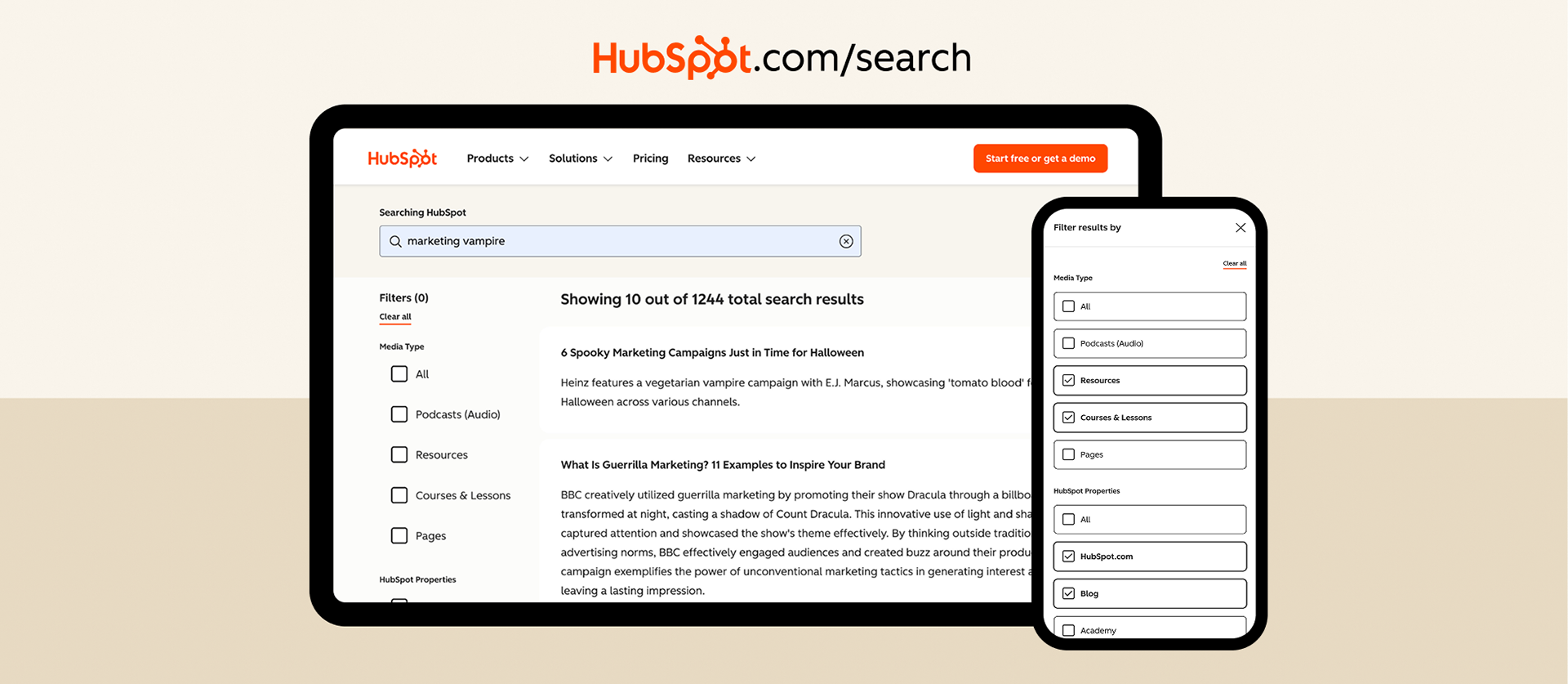
The Deep Dive
GenAI Search: Reframing Search as a Discovery & Demand Engine
Transforming HubSpot.com search from a hidden utility into an omni-channel, Al-summarized demand generation lever.
Role: Lead UX Designer (Strategy, Architecture, & Interaction)
Company: Hubspot (2024 - 2025)
Scope: Product Design, UX Strategy, Growth Architecture, Mobile-First, GenAI, Acquisition Marketing
Partners: Engineering, MarTech AI Solutions, Marketing Web Strategy, QA, Data Analytics, SEO
Duration: 6 months
Company: Hubspot (2024 - 2025)
Scope: Product Design, UX Strategy, Growth Architecture, Mobile-First, GenAI, Acquisition Marketing
Partners: Engineering, MarTech AI Solutions, Marketing Web Strategy, QA, Data Analytics, SEO
Duration: 6 months

The Context
HubSpot.com is a primary channel for new customer acquisition, yet its search functionality was handled as a limited feature without growth potential.
The Challenge (Business Problem)
High Intent Meets Missed Opportunity
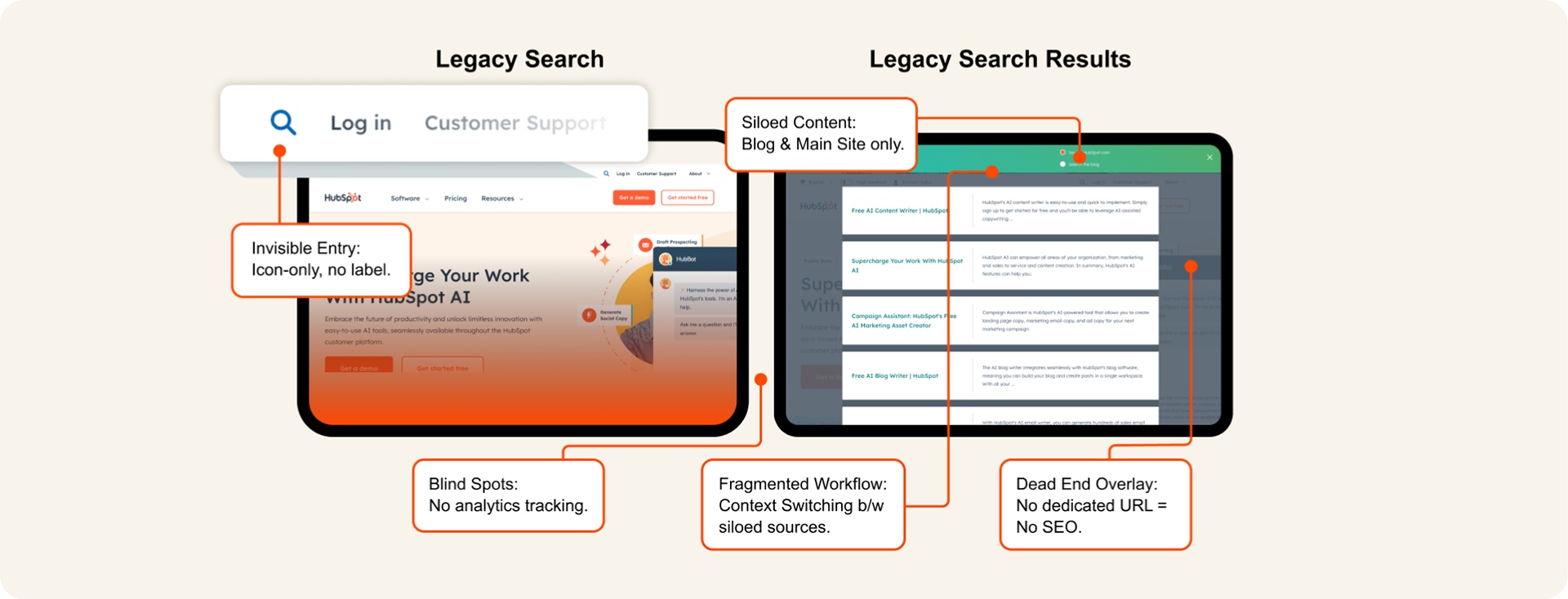
Search was historically treated as a hidden utility with no analytics or strategic play. Despite high user intent, the legacy experience created dead ends that resulted in unrealized business value and missed growth opportunities.
The Business Gap:
➜ Missed Measurement: The legacy lightbox overlay architecture prevented URL-based tracking, making it impossible to measure high-intent behavior.
➜ Missed Discovery: Indexing only siloed content was limited to the Blog and main site; high-value assets like the Academy and Knowledge Base remained invisible, obscuring relevant solutions from users.
➜ Missed Demand Gen: Without the ability to track or analyze queries at scale, search could not be used to qualify leads or optimize self-serve conversion paths.
The User Problem (Heuristic Friction)
➜ Discoverability: Unlabeled entry point. Poor accessibility of search utility.
➜ Fragmented User Flow: Scattered rather than centralized information. Users forced context switching, zig-zag between silos resulting in multiple tabs info paralysis.
➜ Source Limitations: Users provided with only two web properties to query against.
➜ Mobile Failure: Non-responsive overlay alienated serious amount of traffic.
Ownership
Led the strategic transformation of HubSpot’s search from an outdated legacy overlay into a responsive, omni-channel discovery engine that utilizes generative AI to deliver personalized summaries across diverse content types and drive measurable demand generation.
The Scope: Defining Boundaries to Ensure Quality
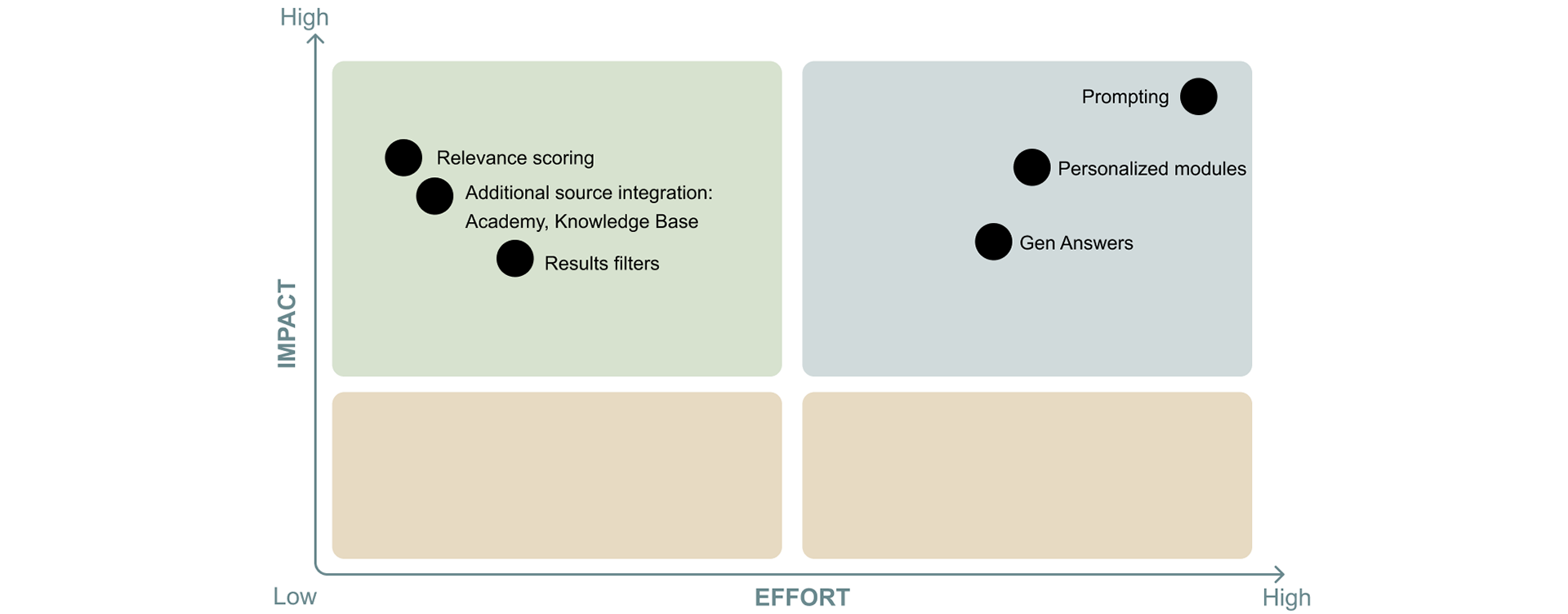
Prioritizing foundational improvements over speculative features.
IN SCOРЕ
✔ HubSpot.com site search
✔ Discovery across additional web properties (Blog, Academy, Knowledge Base)
✔ Self-serve exploration and education
OUT OF SCOPЕ
× Paid acquisition channels
× In-app (product) search
× Third-party sites
The Constraints
➜ Scalability: Consistent content model to normalize disparate metadata from multiple distinct sources
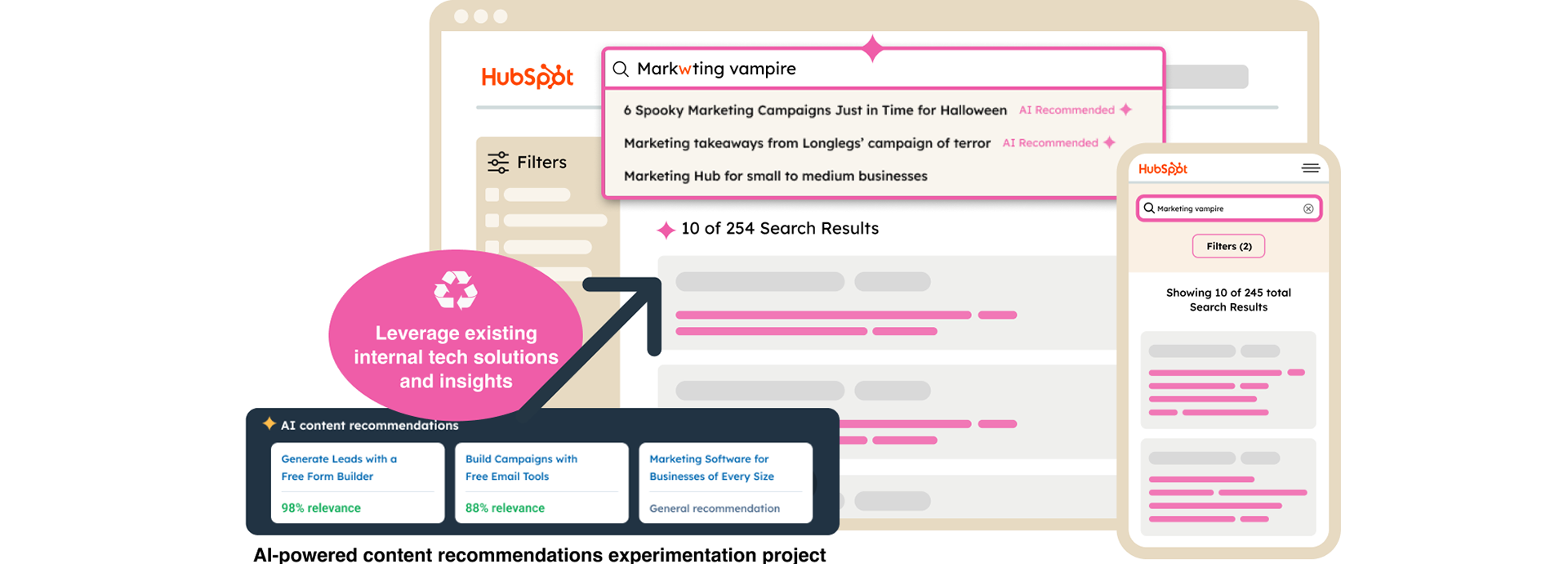
➜ Bounded Summaries: To prevent hallucinations, GenAI was restricted to synthesizing page-level content rather than providing ungrounded answers. Summaries were intentionally bounded and framed as "assistive" to guide users toward the source while building trust through explainable intelligence.
➜ Responsiveness Guardrails: Content length limits were enforced on AI summaries to prevent layout shifts and maintain high information density. This prioritized mobile ergonomics and vertical scrolling, treating mobile as a native experience rather than a desktop adaptation
➜ AI Latency: Account for "The Black Box" AI generation delay to prevent user abandonment during potential few seconds LLM summarization window.
➜ Launch Timeline: Leveraging existing internal research and validated UI patterns to accelerate time-to-market.
Strategic Opportunity
Shifting the Paradigm: Search as a Behavior, Not a Channel
Users search everywhere. Evolve HubSpot search from a static keyword lookup into a unified AI discovery system, bridging content silos to unlock the data visibility needed to drive cross-platform demand generation.
The Solution Approach
A platform-level redesign migrating search from a restricted overlay to a dedicated results page to enable full-funnel tracking. This discovery engine unifies multi-source fragmented content (Main site, Blog, Academy, etc.) and utilizes restrained, explainable features by leveraging existing internal AI tech infrastructure and validated user isights.

Guiding Principles for a Scalable System
✔ Discoverability First: Make it visible, inviting, and easy to engage.
✔ Intent over Keywords: Optimize for what users want to accomplish.
✔ Progressive Intelligence: Introduce Al assistance gradually to build trust.
✔ Explainability: Show why results appear (relevance).
✔ Scalable Systems: Design once, apply across all properties.
Key Design Decisions
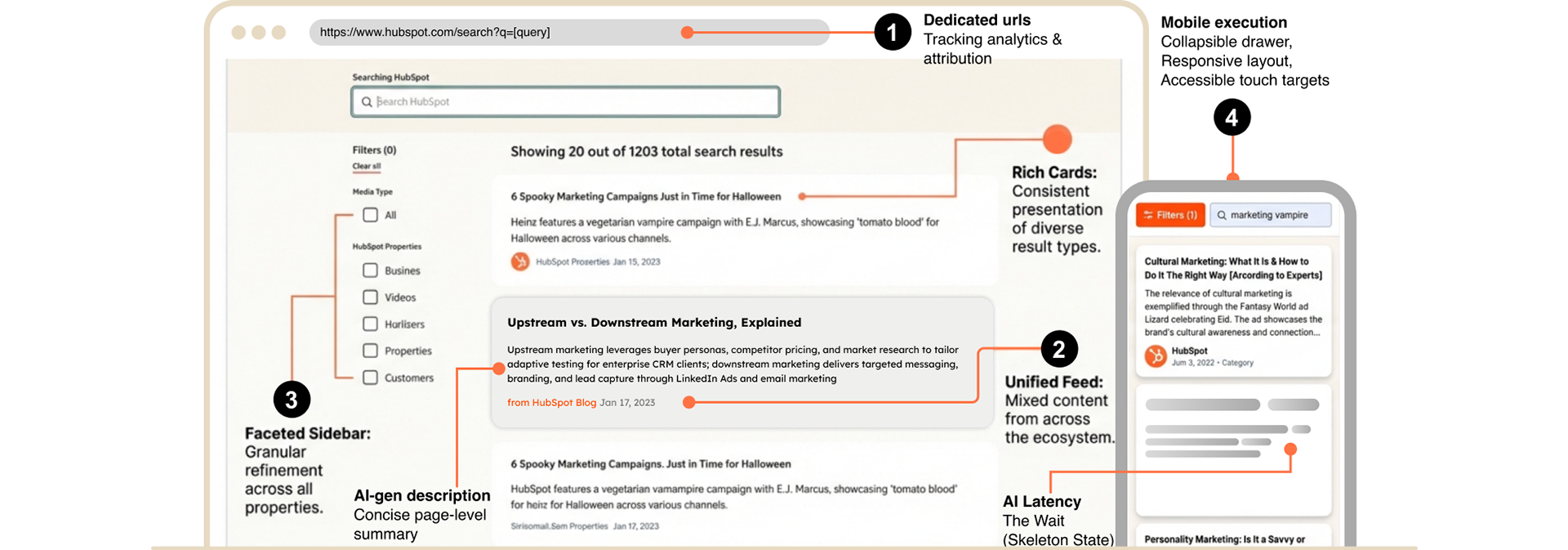
1. Architecture Pivot: From 'Search as a Widget' to 'Search as a Destination'.
This core architectural shift transitioned from a lightbox overlay to a trackable results page. It unlocked growth and supported the business impact by:
➜ SEO & Sharing: Dedicated URLs allow crowlers to index results and users to share specific query pages.
➜ Analytics & Attribution: Enables tracking of search performance and connecting it to downstream conversions.
➜ Experimentation: A stable canvas for future A/B testing

2. Multi-Source Discovery: To align with user's mental model (by topic and intent) the Search was redesigned to break down content silos, surfacing results from various distinct sources such as text from HubSpot Blog articles and HubSpot.com pages, courses from HubSpot Academy, and documentation from the Knowledge Base. To support all that a Unified Cross-Property Card System was designed as a scalable content model based on single, scannable feed of "topic cards" that consistently harmonize metadata from various sources.
3. User Transparency: Before introducing advanced AI behaviors, the focus was placed on relevance scoring and filtering, giving users visibility into why results appeared and the controls to narrow them. To support that we leveraged existing research insights and validated findings that matched the current user goals and intent.
4. Responsive Infrastructure: Introduced a filter system that gracefully transitions from a multi-select sidebar on desktop to a mobile-first drawer, ensuring that complex search controls remain "thumb-friendly" on small screens. The designs also accounted for AI system latency during real-time LLM summarization.
Outcomes
Shipped A Modern Foundation for Discovery
Note: While hard KPIs are pending, the structural transformation was the primary success metric for this phase.
✔ Strategic Win: Shifted perception of search from 'utility' to 'growth vehicle'.
✔ Infrastructure Win: Enabled attribution tracking and SEO-friendly indexing of search results delivering insights for high business impact.
✔ Experience Win: Established Al-guided scalable foundation with multi-source architecture.
✔ Efficiency Win: Successfully leveraged existing internal AI solutions and research insights to bypass technical debt and accelerate deployment.
Key Takeaways
➜ Intent over Volume: AI Search may not spike total traffic, but it acts as an accelerator for high-value prospects, significantly increasing the quality of the conversion path.
➜ Utility over Magic: The most impactful Al experiences feel obvious, restrained, and user-controlled. They prioritize transparency and explainability over being "impressive" or purely novel.
➜ Systems over Features: Integrating a successful GenAl Search was less about adding raw intelligence and more about designing a scalable foundation that allows AI to earn its place and trust within the ecosystem over time.